| Auteur | Martine Vanryckeghem en Gene Brutten |
| Prijs | € 59,00 |
| Extra | 40 pagina's |
| ISBN | 9789058730985 |
| Categorie | Spraak & taal |
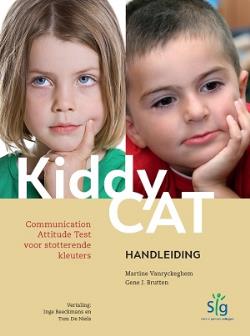
De KiddyCAT is een test om de communicatieve attitude van kleuters te meten. De test maakt het mogelijk om na te gaan of de spraakattitude van stotterende kleuters verschilt van die van niet-stotterende kleuters.
De KiddyCAT brengt de reacties van kleuters in kaart tegenover hun spraakvaardigheden. Dit toont het belang aan van de spraakgeassocieerde attitude als een gedragsmatige dimensie. Naast onvloeiendheid vormt ze een noodzakelijke aanvulling bij het identificeren van kinderen die stotteren. De therapeut krijgt dus een zicht op de inwendige reacties van een stotterend kind, reacties die aangekaart moeten worden om de therapie succesvol te laten verlopen en om vloeiendheid op lange termijn in stand te houden.
De KiddyCAT (Communicatie Attitude Test voor stotterende kleuters) werd ontwikkeld door Martine Vanryckeghem en Gene J. Brutten en verscheen in 2007 in de Verenigde Staten. Sindsdien is de waarde van het instrument internationaal onderzocht in 24 verschillende landen. Alle studies tonen consequent aan dat stotterende kleuters vanaf de leeftijd van drie jaar statistisch significant hoger scoren op de KiddyCAT in vergelijking met hun niet-stotterende leeftijdgenootjes. Zo staat ontegensprekelijk vast dat de KiddyCAT een bruikbare test is om te bepalen of stotterende kinderen, vanaf drie jaar, negatief denken over hun spraak en de manier waarop ze spreken.
De test is volledig psychometrisch onderbouwd en genormeerd voor Vlaanderen en Nederland. De normering dateert van 2013-2014 en is gebaseerd op 264 niet-stotterende en 249 stotterende kleuters.
Noot: scoreformulier en antwoordsleutel zijn opgenomen in de handleiding. Wie de handleiding aanschaft, kan het scoreformulier voor eigen gebruik kopiëren.
Hieronder een overzicht van recensies over de KiddyCAT, met heel lovende commentaren:
Clark, C., Conture, E., Frankel, C., & Walden, T. (2012). Communicative and psychological dimensions of the KiddyCAT. Journal of Communication Disorders, 45, 223–234. doi:10.1016/j.jcomdis.2012.01.002
“This independent replication suggests at least two thing:s 1) the KiddyCAT is one viable, seemingly reliable means for distinguishing the speech-associated attitudes of preschool-age CWS from preschool-age CWNS and 2) even at this young age, at or near the onset of stuttering, preschoolers have formed or are forming attitudes towards speaking that may either facilitate (in the case of CWNS) or inhibit (in the case of CWS) their ability to establish normally fluent speech-language planning and production” (p. 230).
“Taken together, the single factor—‘‘speech difficulty’’—underlying the KiddyCAT appears related to communicative and psychological processes. This factor seems appropriate on both empirical (i.e., principal components analysis) as well as conceptual (i.e., the quality of the factor) grounds. Thus, present findings support the inclusion of the KiddyCAT as part of a comprehensive approach to the assessment of childhood stuttering. These findings also appear to help improve our ability to interpret KiddyCAT findings as well as further our understanding of how attitudes and awareness contribute to developmental stuttering in preschool-age children” (p. 232).
Stokke Guttormsen, L., Kefalianos, E., & Næss, E. (2015). Communication attitudes in children who stutter: A meta-analytic review. Journal of Fluency Disorders, 46, 1-15.
http://dx.doi.org/10.1016/j.jfludis.2015.08.001
“The KiddyCAT and the CAT have been extensively researched, both instruments showing good validity and reliability” (p. 3).
“In line with many studies of communication attitudes (e.g. Clark et al., 2012; De Nil & Brutten, 1990; Kawai et al., 2012; Vanryckeghem et al., 2001) our results confirm that CWS have significantly more negative communication attitudes than CWNS. The difference between CWS and CWNS was evident for preschool and school-aged children” (p. 9).
“Measurement of communication attitudes prior to commencing treatment and after completing treatment is necessary to determine whether (1) children with more negative communication attitudes respond as effectively as children with less negative communication attitudes to treatment; (2) communication attitudes influence treatment time; (3) effective treatment impacts on a child’s communication attitudes; (4) the presence of negative communication attitudes after treatment heightens the risk of relapse” (p.12).
Groner, S., Walden, T., & Joness, R. (2016). Factors Associated With Negative Attitudes Toward Speaking in Preschool-Age Children Who Do and Do Not Stutter. Contemporary Issues in Communication Science and Disorders, 43, 255-267.
“…the KiddyCAT is consistently able to capture the negative attitudes that preschool CWS have toward the difficultness of their speech. Using the instrument as part of a continuing, holistic assessment of the nature and impact of young children’s stuttering to create the most effective treatment plans is recommended” (p.263).
"Illumination of exactly how CWS’s attitudes toward their stuttering change with recovery would be an invaluable addition to SLPs’ arsenals” (p. 263).
“The KiddyCAT most saliently measures whether children perceive speech as difficult” (p. 264).
“..using both caregivers’ data about their children’s speech and the children’s own self-reported attitudes could give clinicians a better picture of how stuttering impacts their clients outside the narrow window of a clinical setting” (p. 264).
“…the KiddyCAT is a useful tool in the comprehensive assessment of childhood stuttering (p. 266).
Winters, K., & Byrd, C. (2021). Predictors of communication attitude in preschool-age children who stutter. Journal of Communication Disorders, 91. https://doi.org/10.1016/j.jcomdis.2021.106100
“…useful recommendations for speech-language pathologists working with preschool-age children who may stutter. First, because stuttering severity does not predict communication attitude, clinicians should incorporate an assessment of communication attitude in their evaluation of preschool-age children who may stutter” (p. 7).
“…clinicians should also consider negative communication attitude as a target for intervention” (p.7).
“ Facilitating and maintaining a positive communication attitude in early childhood may further support children as they enter elementary school” (p.7).
“… there is evidence to support early intervention for your children who stutter in order to facilitate positive communication attitudes…” (p.7).
Winters, K., & Byrd, C. (2024). Caregiver Predictions of Their 3-to 6-Year-Old Child Who Stutters’ Communication Attitude. Journal of Speech-Language and Hearing Research, https://doi.org/10.1044/2024_JSLHR-23-00662
“ The KiddyCAT (Vanryckeghem & Brutten, 2007) is the only standardized self-report scale measuring children’s cognitive reactions to communication, or speech-associated attitude, in children under 7 years of age” (p.2).
“The KiddyCAT consistently demonstrates group differences between young children who stutter and who do not stutter” (p.7).
“ … these data support both clinical and research efforts to measure cognitive components of stuttering separately from analyses related to observed stuttering behaviors” (p. 15)
“SLPs … [should] also consider a change in communication attitude as an independent, clinically meaningful intervention outcome” (p. 15).
BESTELLEN